
INSIGHTS
E-commerce delivery SLAs: what fulfillment teams should measure
Author: Kamil Doroszko · Published: · Last updated:
7 min read
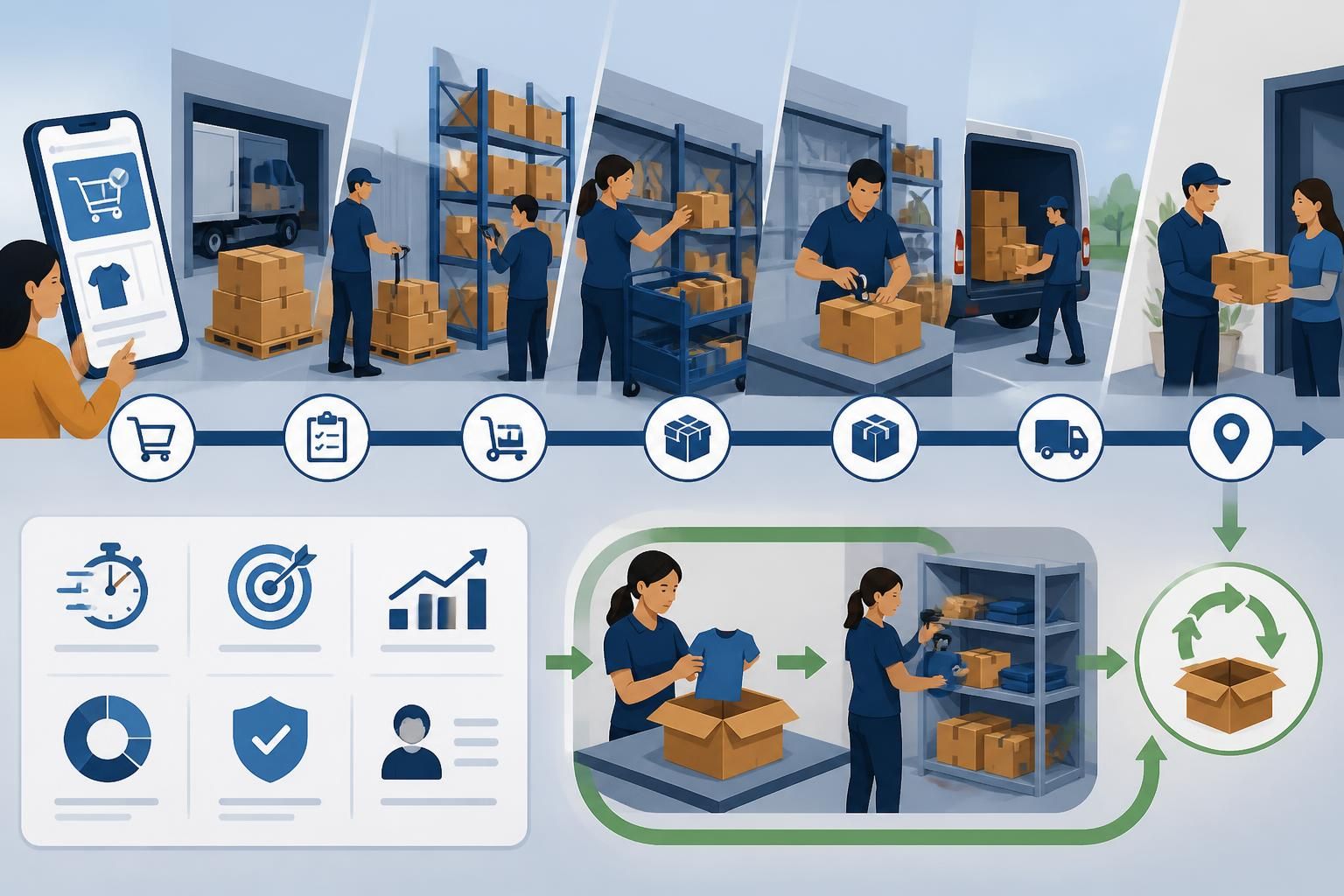
Delivery SLAs are often discussed as if they begin with the carrier, but in e-commerce they are usually shaped much earlier: by receiving, stock accuracy, picking, packing, handover timing and returns handling. If you want more predictable delivery performance, it helps to measure the whole fulfillment flow, not only the final shipment scan.
For an online store, an SLA is a practical promise: an order should be processed within a defined cut-off, prepared correctly, handed to the carrier on time and delivered within the expected window. That sounds simple, yet teams often discover that the weakest part of the chain is not transport alone. It may be a late inbound receiving batch, missing stock data, an unclear packing priority rule or a returns queue that absorbs staff capacity during peak days. This is why e-commerce delivery SLAs should be treated as an operational dashboard, not a marketing slogan.
If you are comparing outsourced support, useful starting points are Labran Logistics services for fulfillment, storage, picking and packing, returns processing and cross-docking. Those pages explain the service scope, while this article focuses on what to measure and why it matters.
1. Define delivery SLAs in an e-commerce fulfillment context
In fulfillment, delivery SLAs usually describe the speed and reliability of the order journey from checkout to delivery. A useful SLA definition should begin with the order event itself. Which orders are eligible for same-day processing? What happens after the cut-off? Which destinations or service levels are included? What counts as “on time” for dispatch and what counts as “on time” for delivery?
It also helps to separate internal and external service levels. Internal SLAs cover the warehouse work that the fulfillment team controls directly: stock availability, order release timing, picking accuracy, packing completion and parcel handover. External SLAs cover the carrier journey after dispatch. When these are blended into one number, it becomes difficult to see whether delays are caused by warehouse processes, carrier performance or incorrect customer data.
For a clearer process view, many stores track the order lifecycle step by step: order received, order released, item picked, parcel packed, parcel handed over, shipment scanned and delivered. That structure makes it easier to identify whether an SLA miss began in the warehouse or during transport.
2. The most useful service levels to track
The most practical service levels are the ones that show where the process slows down. Start with the order processing time from order placement to handover. Then measure picking accuracy, packing accuracy, same-day dispatch rate and the percentage of orders released before the cut-off. These indicators reveal whether the warehouse can actually support the delivery promise made to the customer.
Another important metric is inventory / stock availability. If online stock is inaccurate, the fulfillment team may accept orders that cannot be processed on time. Even a strong carrier network cannot repair the delay caused by a missing item or a manual stock correction. In that sense, stock quality is a delivery SLA metric, not only a finance or planning metric.
Returns also deserve a service level. Returned items that are not checked, sorted and put back into available inventory quickly can create artificial shortages and delay future dispatches. A store may see this as “delivery performance,” but the real bottleneck sits inside returns processing.
Other helpful indicators include the share of orders shipped complete, parcel damage rate, first-attempt delivery success where relevant, and the percentage of orders that require manual intervention. None of these should be treated in isolation. A rising dispatch speed with a falling accuracy rate is not a true improvement.
3. How fulfillment, picking, packing and returns affect SLA performance
Fulfillment sets the tempo for the rest of the chain. If inbound receiving is delayed, stock cannot be made available fast enough. If storage logic is unclear, teams spend more time locating items. If picking routes are inefficient, wave processing slows down. If packing materials are inconsistent, the final stage becomes a bottleneck. Each of these issues can reduce the share of orders that leave the warehouse before the cut-off.
Picking accuracy directly influences delivery promises because every mispick creates rework: the wrong item must be found, corrected and shipped again, while the original order is already late. Packing affects SLAs in two ways. First, slow packing extends the order cycle time. Second, poor packing can increase damage, which creates returns and replacement work that consume capacity later.
Returns are often ignored when SLA reports are built, yet they affect future delivery performance. If returned goods are slow to process, the inventory / stock picture becomes unreliable. That can make the team promise a faster delivery window than the warehouse can support. Good returns processing shortens the time between product return and re-availability, which helps protect future order promises.
For cross-docking operations, the main SLA question is different: can the goods pass through the process quickly enough to avoid unnecessary storage and still hit dispatch timing? In that model, timing, coordination and handover discipline matter as much as classic warehouse storage processes.
4. Why SLA misses happen in outsourced logistics
SLA misses in outsourced logistics are usually caused by process mismatches rather than a single failure. The most common examples are incomplete order data, poor forecast visibility, late carrier booking, unclear cut-off rules, unexpected order spikes and insufficient alignment between the store and the fulfillment team.
Another frequent reason is that the store assumes the service provider has the same view of priority as the sales team. In reality, the warehouse needs explicit rules: which orders are urgent, which orders are blocked, which orders require special packaging and what to do when a product is temporarily unavailable. Without that clarity, the team can work quickly and still miss the intended service level.
Capacity issues can also create SLA misses during promotions or seasonal peaks. If the inbound schedule, storage layout and picking plan are not adjusted in advance, a process that works well at normal volume may start failing on busy days. Outsourced logistics works best when the commercial plan and warehouse operations are aligned early enough to adapt.
Sometimes the cause is outside the warehouse entirely. A carrier can miss a collection window, destination data may be incomplete, or the selected transport service may not fit the delivery promise. That is why delivery SLAs should be monitored across the entire chain and discussed alongside service design, not only after problems appear.
5. Turning SLA data into better logistics decisions
Once you measure the right indicators, the next step is to use them for decisions. If order processing time is weak, review cut-off rules and labour allocation. If picking accuracy is unstable, improve slotting, scanning or item verification. If packing speed is slow, check packaging standards and workstation setup. If returns are causing stock inaccuracies, tighten the returns workflow and the rebooking process.
Good SLA reporting should answer three questions: what failed, where it failed and what the business consequence was. That makes it easier to decide whether you need a change in warehouse flow, a stronger carrier setup or a broader outsourced fulfillment model. It also creates a better basis for supplier discussions, because the conversation moves from “delivery is late” to “this step in the process needs support.”
If your store is reviewing its logistics model, explore Labran Logistics services for fulfillment and returns processing, then speak with the team through the contact page. If your current process is already stretched, a focused fulfillment quote can help you compare the operational fit before the next peak period.
In short, e-commerce delivery SLAs are not just about parcels arriving on time. They are the result of storage, picking, packing, dispatch discipline and returns quality working together. The better you measure each stage, the easier it becomes to protect customer expectations and keep the process stable.