
EUROPEAN ECOMMERCE OPERATIONS
Ecommerce Fulfillment in Europe: Costs, Delivery and Returns from a Polish Hub
Author: Kamil Doroszko · Published: · Last updated:
10 min read
Choosing ecommerce fulfillment in Europe means choosing how inventory, orders, deliveries and returns will work together. Start with a comparable operating model, then test whether one stock pool in Poland can support your customers and channels.
What does ecommerce fulfillment in Europe include?
A European fulfillment operation receives your goods, records and stores inventory, processes ecommerce orders, packs parcels and hands them to the selected carriers. Depending on the agreed scope, it also handles returns, product identification, inserts, bundles and other warehouse work. The useful question is how those tasks fit your products and sales channels.
For a business entering Europe, the warehouse is only one part of the setup. You also need an order-data flow, a stock policy, delivery services by destination, a returns process and named owners for exceptions. A list of warehouse services does not establish who will deal with an unknown SKU, a short delivery or a returned item awaiting a decision.
A practical shortlist therefore starts with your operating profile: order volumes, average units per order, active SKUs, stock cover, parcel dimensions, destination mix and return rate. Give each provider the same profile. That makes the resulting quotes much easier to compare.
How to choose a European fulfillment center
Assess the actual dispatch postcode and the services offered from it. “A warehouse in Europe” is too broad to predict delivery performance. A site can be geographically close to your main market yet have different collection times, carrier services or return arrangements from another site in the same country.
| Decision | What to check | Evidence to request |
|---|---|---|
| Customer destinations | Order share by country, important postcodes and delivery options. | A lane-by-lane service proposal for your parcel profile. |
| Inventory | Average and peak stock, replenishment frequency and slow-moving lines. | A storage model using the same units and period for every quote. |
| Daily operation | Order import, pick and pack, exception handling and handover. | A test order and a clear cut-off definition. |
| Returns | Where parcels arrive, inspection scope and restocking decisions. | A test return showing its status and inventory update. |
| System fit | Channel connections, SKU mapping, stock reservations and tracking. | A demonstration using the workflow you expect to run. |
Labran operates from Poland and supports ecommerce orders for customers in markets including Poland and Germany. Its operation in Dębno is the starting point for evaluating the model. Discuss other European destinations separately rather than assuming that the same lead time or price applies everywhere.
One stock pool or several local warehouses?
One stock pool can make inventory easier to manage. You do not have to decide in advance which country needs each unit, and a slow-selling SKU is not automatically stranded in a separate local warehouse. The trade-off is that the dispatch lane must still meet the customer promise at an acceptable cost.
Several warehouses may fit a different order profile: substantial demand concentrated in distant markets, channel-specific requirements, or a service promise that one location cannot meet. The comparison must then include duplicated stock, replenishment between locations, additional receipts and the work needed to keep availability consistent.
Model both options for the same sales pattern. Ask what happens when demand shifts, one warehouse runs out of a popular product, or returned stock becomes saleable in a different country from the next order. The location decision is also an inventory decision.
Compare the full cost of European fulfillment services
Pick-and-pack prices are useful inputs, but they are not a complete monthly cost. Your stock can be expensive to hold even when few orders go out. Conversely, a small stock footprint with many multi-unit orders can shift the cost towards handling. Compare the full month at ordinary and peak volumes.
| Cost block | Typical quantity driver | Question for the quote |
|---|---|---|
| Receiving | Inbound deliveries, cartons, pallets or units. | Which checks and data preparation are included? |
| Storage | Agreed occupied space and charging period. | Is the rate per month, pallet-day or another unit? |
| Order processing | Orders and product units within them. | Are additional items, inserts and bundles priced separately? |
| Packaging | Number and type of materials used. | What is included in packing and what is a material charge? |
| Delivery | Destination, parcel profile and chosen service. | Which supplements are confirmed for this route and product? |
| Returns | Parcels and agreed inspection or rework. | What happens before an item becomes available again? |
| Minimum and additional work | The agreed service scope and monthly activity. | Which operations count towards the minimum? |
Keep each calculation in one currency. If quotes use different currencies, record the exchange-rate assumption and date before comparing totals. Do not convert a rate by changing its currency label. Recheck the comparison when the stock profile, carrier service or quote conditions change.
A model for 300, 1,000 and 5,000 monthly orders
Use the following example quantities to make quotes comparable. These are planning assumptions, not a claim about a typical brand: 1.5 units per order, returns equal to 5% of orders, and separately defined storage and inbound activity. Replace them with your own data before making a decision.
| Monthly input | 300 orders | 1,000 orders | 5,000 orders |
|---|---|---|---|
| Product units shipped | 450 | 1,500 | 7,500 |
| Average shelving space | 2 m³ | 5 m³ | 20 m³ |
| Returns handled | 15 | 50 | 250 |
| Inbound master cartons | 20 | 60 | 250 |
| Outbound packaging units | 300 | 1,000 | 5,000 |
Apply the quoted unit rates to those quantities. Add the appropriate minimum adjustment, additional warehouse work, packaging and the transport mix. If an order produces more than one parcel, update packaging and transport quantities as well. Storage must follow the actual inventory plan, not be inferred from order count alone.
The model is deliberately a way to use your quote. Labran’s pricing page explains how to request an individual assessment of your process. A universal price would conceal important differences between products, stock levels and services.
Delivery promises need a lane, a cut-off and exceptions
Ask the provider to separate order readiness, dispatch and delivery. An order imported after the agreed cut-off may enter a different dispatch cycle. A parcel being handed to a carrier is a different event from the recipient accepting it. Your store promise should reflect the agreed service and the evidence available in tracking.
For Poland and Germany, discuss Labran’s 24-hour delivery proposition against the specific service, destination and operating conditions. Confirm collection days, cut-offs, parcel restrictions and how exceptions are reported. For other European destinations, request their own route and service assumptions.
A useful test includes an ordinary order, an order close to cut-off and an exception such as an address correction. Check when each status appears in the warehouse system and in your sales channel. This gives you a clearer basis for setting customer expectations than a single “fast shipping” headline.
Returns are an inventory process as well as a parcel process
A return arriving at a warehouse does not automatically mean that its products can be sold again. Agree how the parcel is identified, what is inspected, which decisions require the brand’s approval and how those decisions change stock availability. Make the rules specific enough for the warehouse team to follow consistently.
Also define the handling of incomplete returns, damaged goods, unidentified items and products needing rework. The service scope, evidence and extra-work approvals affect both cost and the customer experience. If return parcels travel across borders, compare that transport flow separately from outbound delivery.
See the scope of returns handling and include a real return in your pilot. The important result is a traceable decision and a correct inventory update, not simply a “received” status.
Test the WMS and integration before transferring stock
Labran develops its own WMS to connect warehouse operations, customer visibility and integrations. Its interface supports 9 languages and mobile access. The system’s AI agent operates within the user’s permissions. These capabilities should be evaluated through the tasks your team will actually perform.
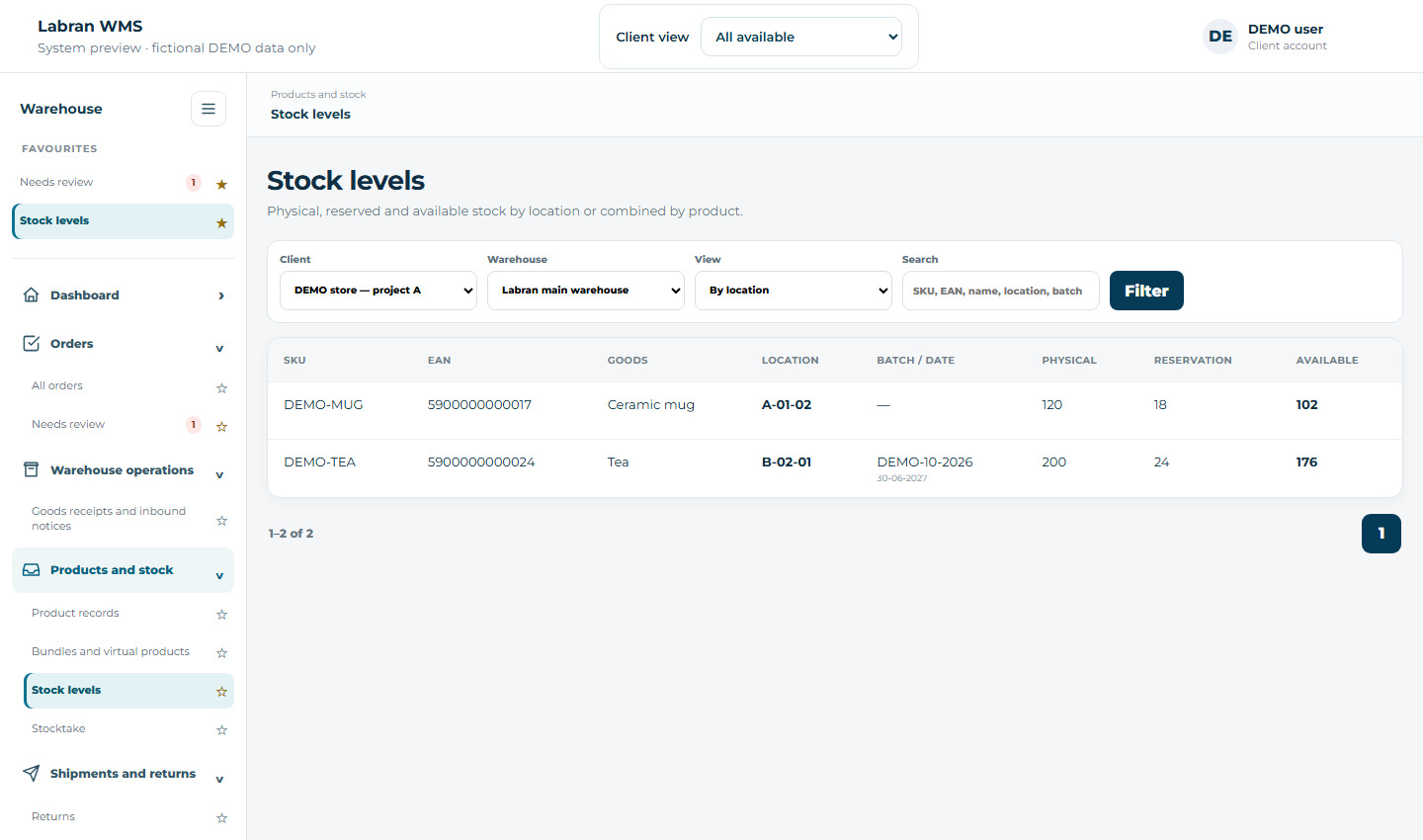
- Map SKUs and confirm the meaning of physical, reserved and available stock.
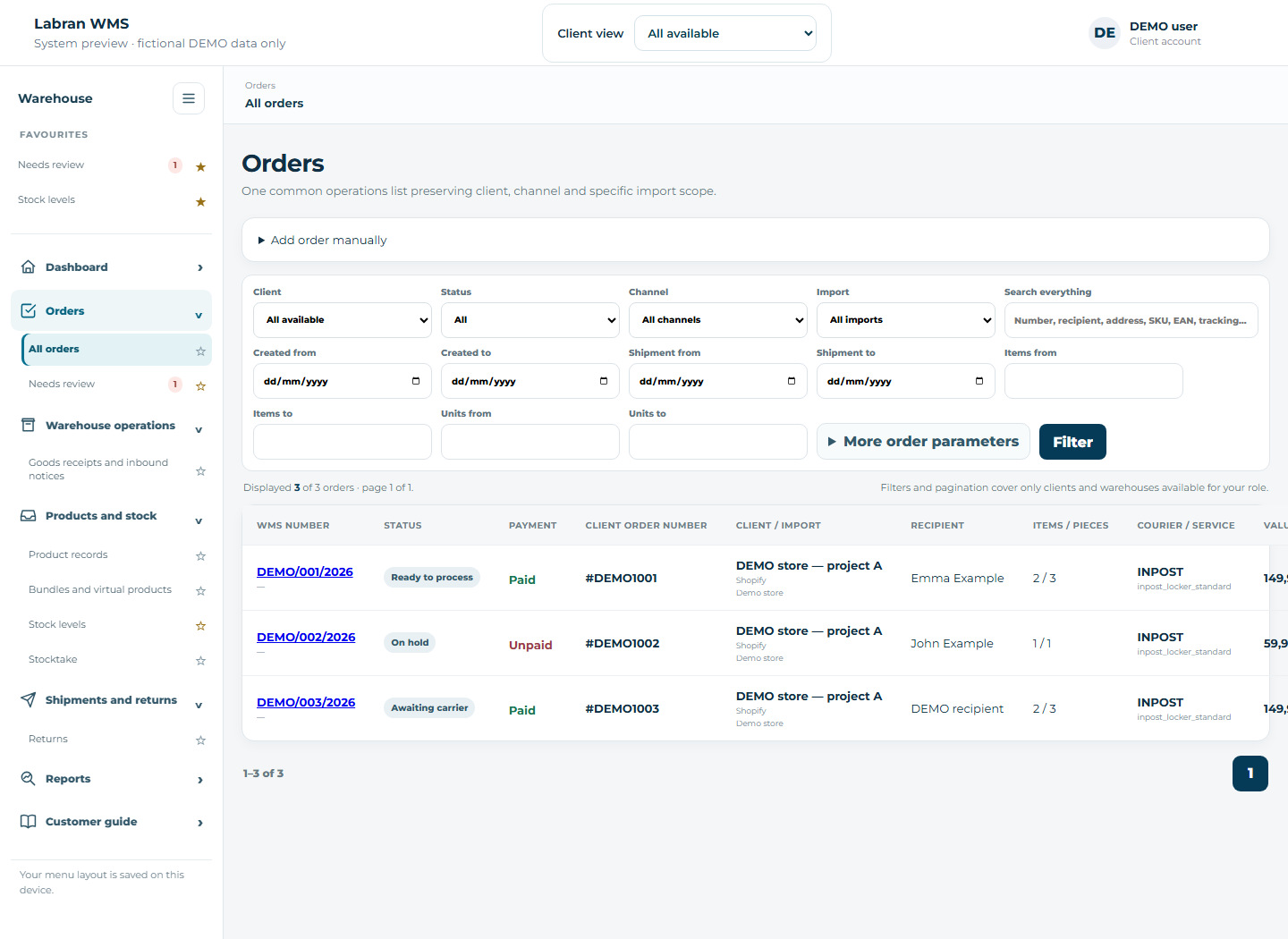
- Send a test order, verify its lines and delivery choice, then follow its progress and tracking.
- Test an unavailable item, an order amendment and cancellation at different process stages.
- Reconcile an inbound delivery and a return with the stock shown to your channels.
- Agree the owners of integration errors, support requests and changes before launch.
Use the technology and integrations overview to prepare the demonstration. A scoped pilot should establish acceptance criteria and responsibilities. Its length depends on the integrations, data quality and operational requirements; agree the timetable for your setup.
What to send with a European fulfillment quote request
- Ordinary and peak monthly orders, seasonality and the destinations you expect to serve.
- SKU count, average units per order, dimensions, weights and handling requirements.
- Average and peak stock, inbound schedule, and any identification or product-data tasks.
- Packaging instructions, inserts, bundles and the expected return profile.
- Sales channels, current systems and the required flow of stock, order and tracking data.
- The service promise you want to test and the exceptions your team needs to control.
For the commercial service overview, continue to Fulfillment Europe from a Polish operation. For location-specific questions, read what to evaluate when choosing fulfillment in Poland.
Frequently asked questions
Can one warehouse in Poland serve customers across Europe?
It can be a suitable model, depending on your destination mix, stock and required service. Compare each important lane, its cost and its operating conditions before committing to a customer promise.
Does a European fulfillment quote include shipping?
It depends on the quote. Separate warehouse operations, materials, transport and supplements, then confirm which minimum applies to which services.
Do I need a warehouse in every country I sell to?
Not necessarily. Compare delivery requirements with the cost of duplicated stock and additional locations. There is no single location model that is best for every brand.
How should I compare European fulfillment providers?
Use identical assumptions for orders, units, stock, destinations and returns. Request a complete monthly model and validate the operation with test orders, stock reconciliation and a return.
Is 24-hour delivery available throughout Europe?
Do not assume that one service commitment covers every European destination. Confirm the specific Poland/Germany proposition and request separate conditions for other routes.