

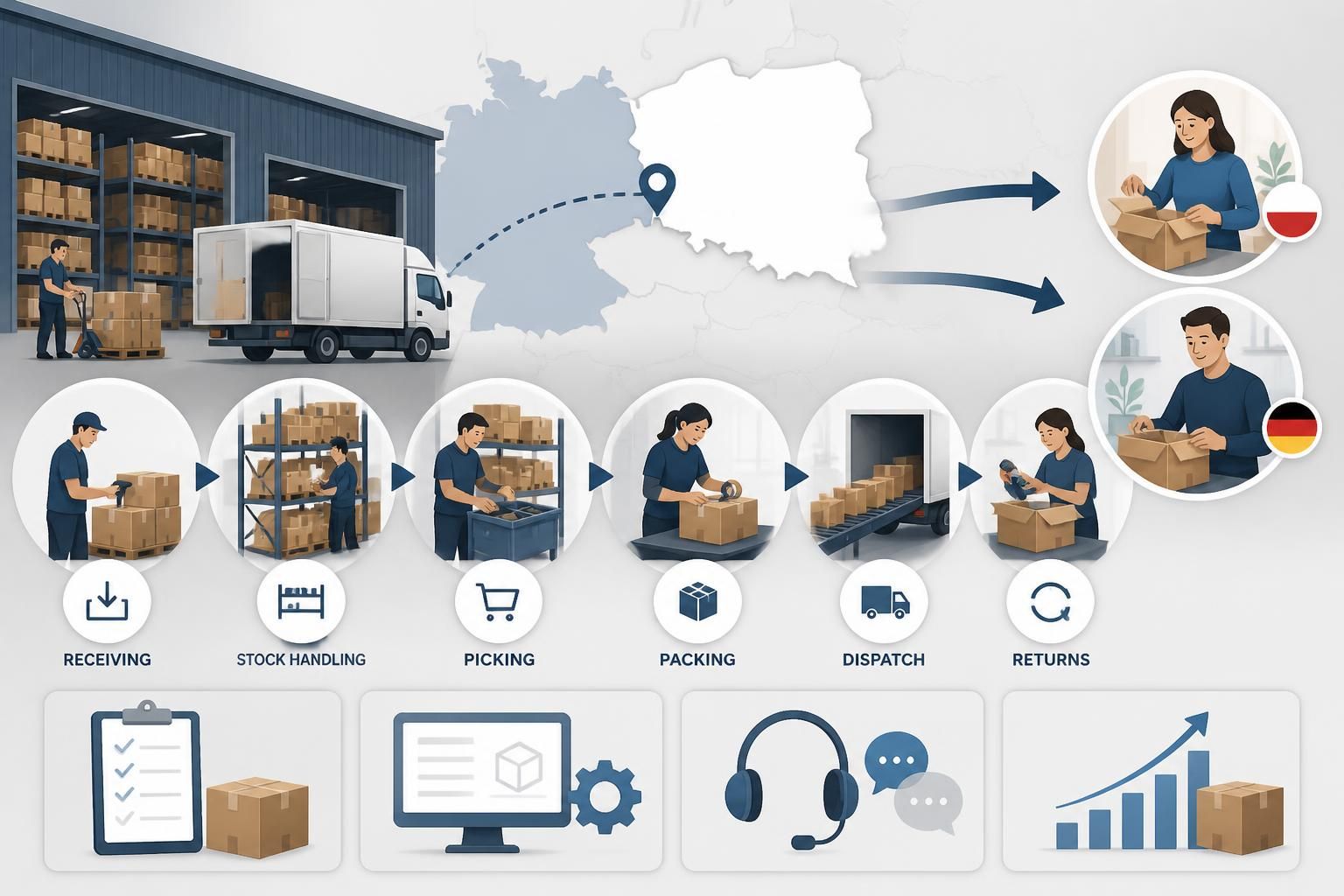
Many ecommerce teams start looking at fulfillment in Poland when they need a practical way to serve customers in Poland, Germany, or both markets from one operating setup. The phrase sounds simple, but the decision is usually broader than storage space alone. A partner has to support the full operational chain: receiving, stock handling, picking, packing, dispatch, and returns. If one part is unclear, the whole process becomes harder to control.
That is why the best comparison starts with questions, not with a price sheet. Ask what is actually included, how the process is organized, and how fast your team can reach the people who run the day-to-day work. If you want to see how these services are presented on the site, start with the services page and the contact page.
Why companies look at fulfillment in Poland
For many online stores, fulfillment in Poland is attractive because it can support a central operating model for regional sales. Instead of splitting the process across several partners too early, a company can evaluate one setup that manages inventory, outbound work, and returns in a coordinated way. That can simplify planning, especially when the business is still refining product mix, order volume, or marketplace strategy.
The real question is not whether fulfillment exists in Poland. The question is whether the partner can handle your products in a way that matches how you sell. For example, some stores need straightforward pick and pack for a limited catalog, while others need more care around receiving quality, stock movement, or returns processing. The same country can support very different operational models, so local fit matters more than a generic promise.
Location also matters in a practical sense. A warehouse setup near the Polish-German route may help reduce operational friction for businesses that sell across both markets, but location should be reviewed together with service scope and communication. If the partner cannot support the processes your team needs, a convenient address alone will not solve the problem.
Key criteria for comparing partners
- Location: confirm where the warehouse operates and whether it fits your target markets.
- Service scope: check receiving, inventory handling, picking, packing, dispatch, and returns.
- Integrations: verify how orders and status updates connect with your store or ERP.
- Communication: understand who answers operational questions and how exceptions are handled.
- Returns handling: ask how returned items are received and put back into stock.
When comparing providers, start with the basics: what space they actually use, what products they are prepared to handle, and which parts of the workflow they cover. Labran Logistics provides 2,000 m² of racking and 3,000 m² of pallet storage space. Those figures describe storage space types, not a new total building area. For many prospects, this is useful because it distinguishes the space available for different storage needs.
Then move to process scope. A serious discussion should cover warehousing, receiving, picking, packing, dispatch, and returns for ecommerce. If the partner describes these steps clearly, you can map them against your own order flow. If the answer stays vague, that is a signal to ask more detailed questions before you move forward.
It also helps to verify whether the provider can support your target markets. Labran Logistics lists Poland and Germany as the service scope. That does not remove the need for a process review, but it gives you a concrete starting point when you are comparing a local operation with a cross-border one.
Another useful point is whether the partner treats scope and pricing individually. That is often a good sign in logistics, because operations differ by product mix, order profile, and required handling. A quote built around your process is usually more meaningful than a generic package that does not reflect how your store actually works. You can compare the operational scope with the pricing page while you review the criteria above.
Service scope and process questions
Before you choose a partner for fulfillment in Poland, ask what happens after stock arrives. How is inbound receiving organized? How is inventory recorded? What checks happen when goods are unpacked or put away? These questions are not theoretical. They help you understand whether the operation is designed for stable day-to-day work or only for basic storage.
Next, ask about picking and packing. How are orders released to the warehouse team? How are items handled if a customer order includes more than one product? How are exceptions managed when the stock position changes or an item needs attention? The more specific the answers, the easier it is to see whether the process will support your store without constant intervention.
Returns deserve the same level of attention. Ecommerce teams often underestimate returns processing until it becomes operationally visible. You should know how returned items are received, how their condition is assessed, and how stock is updated afterward. A partner that can explain the flow clearly usually makes later cooperation easier to run.
Also ask whether the partner supports cross-docking if your flow needs a fast transfer without long-term storage. That question helps you see whether the operation can handle direct movement as part of a broader fulfillment setup, not just warehouse storage. If you need a broader view of the operational scope, the services page is a good place to connect the article to the practical service offering. If your review is already advanced, the contact page is the fastest route to a direct conversation.
Integration and communication checkpoints
Good fulfillment in Poland depends on more than the warehouse floor. Your store, marketplace, ERP, or order management tools need to exchange information in a way that fits your team. That is why integration questions should be part of the evaluation from the beginning. Ask how orders are received, how updates are communicated, and how your team will track progress once cooperation starts. For a deeper look at system connectivity and order-flow visibility, see the Technology and WMS page.
Communication is equally important. You want to know who answers operational questions, how quickly issues are escalated, and how exceptions are handled. This is especially relevant when you are onboarding a partner and need to coordinate data, product structure, and process rules. A clear contact path saves time later, especially when volumes grow or your catalog changes.
If a provider cannot describe the communication model, it becomes harder to trust the service. A strong partner should make it easy to understand where information flows, who owns each step, and how to reach the right person when something needs attention. This is one reason to evaluate the contact process itself, not just the warehouse capacity.
How to move from evaluation to contact
Once you have checked the basics, move from comparison to a concrete request. At that stage, the goal is not to send a generic enquiry. It is to give the partner enough context to respond with relevant questions. Include your store URL if you have one, explain the markets you serve, and mention what parts of fulfillment in Poland you want to review first.
That approach makes the next conversation more useful. It helps a provider understand whether your case is primarily about storage, picking and packing, dispatch, or returns processing. It also helps you assess whether the operation is a fit before you spend time on a longer sales process.
If you want to continue directly, use the contact form below or visit the contact page. For a fuller overview of the company and the operating setup, you can also review the services page before sending your enquiry. To compare the discussion with a concrete reference point, you can also check the pricing page.