

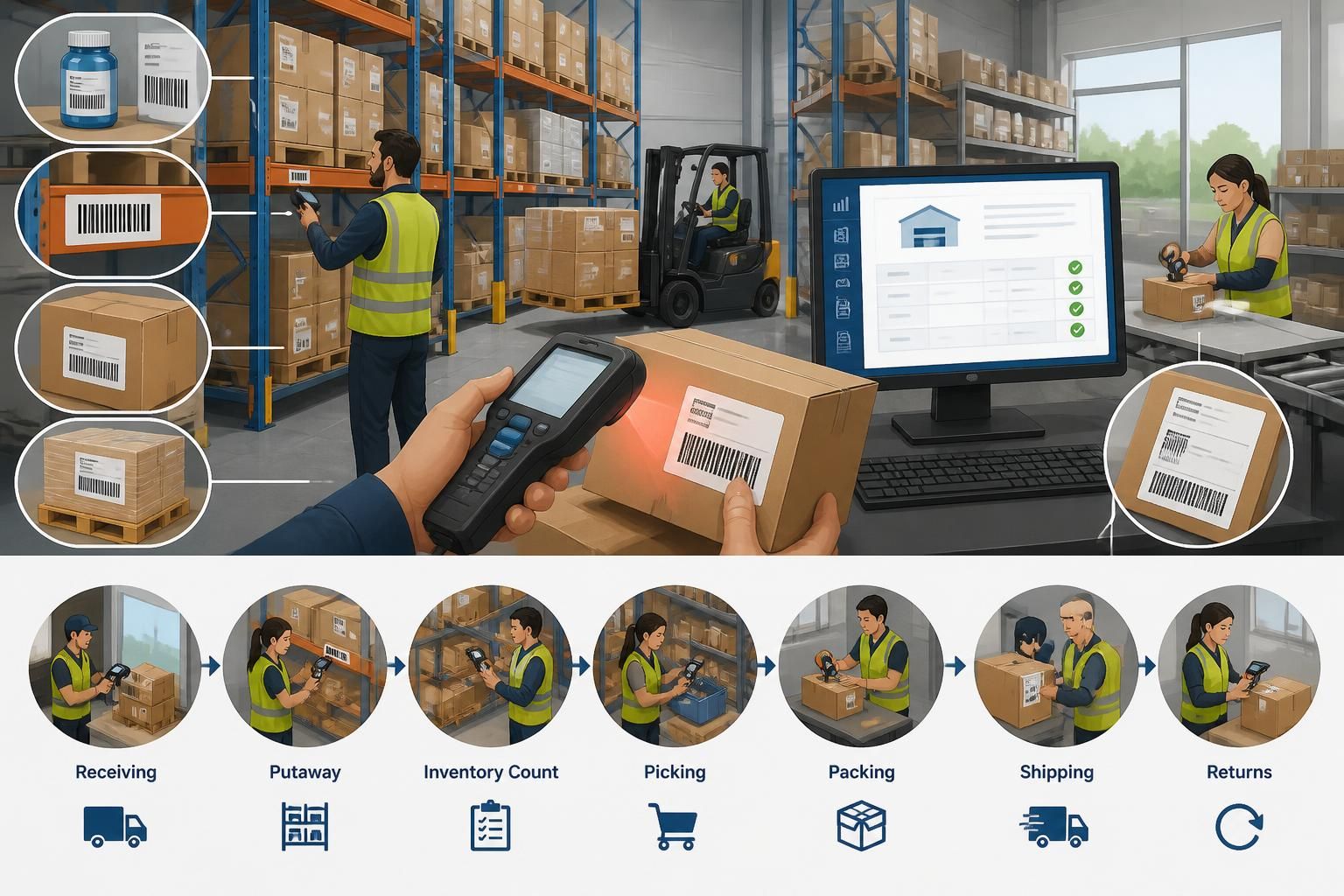
In warehouse logistics, labelling is part of the process, not an afterthought. A clear label tells the team what the item is, where it belongs, which batch it came from, and how it should move next. A barcode lets the same information be captured quickly and consistently through scanning. When that happens, the WMS can update stock, route tasks, and reduce manual typing errors.
The most useful way to think about labels is by function. Product labels identify the item itself. Location labels identify the exact storage position in the warehouse. Carton labels identify the outer packaging that holds several units. Logistics labels identify a pallet, tote or mixed handling unit that must move as one unit through receiving, putaway, transfer, picking, packing or cross-docking. Courier shipping labels are different again: they support the carrier’s transport flow and parcel delivery, but they are not the same as the product identifier inside the box.
What each label is for
A product label usually carries the SKU, name, variant, and a machine-readable code. In many operations it also includes batch or lot data, expiry date, colour, size or serial number. This matters when products need traceability or when picking must follow lot rotation. A location label marks shelves, bins, pallets, floor positions or zone codes, so every scan points to one exact place. Without location labels, the WMS cannot guide putaway or confirm a transfer cleanly.
Carton labels are useful when goods arrive in sealed outer packs. They help identify how many units are inside and whether the carton belongs to one SKU or a mixed set. Logistics labels, often based on a serial shipping container code (SSCC), describe the handling unit rather than the product inside it. That distinction matters in pallet operations: the warehouse may scan the SSCC to move the pallet while the WMS still tracks the individual items that pallet contains.
Courier shipping labels serve transport. They usually include the recipient, service level, routing data and a carrier barcode. They should not be confused with an EAN or another product code. An EAN identifies a trade item; a parcel tracking number identifies a shipment in the carrier network. Using one as if it were the other creates avoidable errors at dispatch and returns.
Where labels and scanning matter in daily warehouse work
At inbound receiving, staff can compare the physical goods with the expected order, scan the product or carton label, and verify quantity before putaway. If the goods require quality checks, the label can show the lot, expiry date or serial data that the team must confirm before the stock is released. This is especially important for products with date sensitivity or mixed batches.
During putaway, the warehouse location label tells the picker or forklift operator where stock should go. A scan of the item and then the location confirms the move in the WMS. The same logic supports location transfers: the system records that stock moved from one bin or pallet position to another, instead of leaving the inventory position unclear.
Inventory counts depend on accurate labels as well. When the team performs a cycle count, they should scan the location and the counted items so the WMS sees exactly what was checked. If labels are damaged, duplicated or missing, counting becomes slower and the risk of mismatched stock grows. The same applies to picking: the picker must identify the right item and the right storage point before removing stock. If a label is duplicated or placed on the wrong carton, scanning may point to the wrong SKU, which creates a picking error even when the physical item looks similar.
How scanning connects to WMS stock
Scanning is the bridge between the physical warehouse and the WMS. Each scan confirms a step: goods received, location confirmed, unit moved, item picked, carton packed, shipment released or return accepted. Because the WMS receives the scan event, stock records stay closer to reality than with manual notes or later data entry. That does not eliminate the need for checking, but it does make each check traceable.
In sorting and packing, labels help the team match the right product to the right order line. If a box contains multiple items, the packer may scan each piece and then the final parcel label before dispatch. In shipping, the courier label is applied only after the contents are confirmed. This helps avoid a common mistake: a parcel being routed correctly while the contents inside are wrong.
Returns processing also depends on reading the label correctly. A returned parcel may arrive with a shipping label, a product label and sometimes an internal return label. The warehouse should confirm what came back, assess damage if needed, and decide whether the item can return to stock. If a label is unreadable or detached, the team may need to rely on order data, serial numbers or a manual check. Even then, the WMS should record the reason for the decision so stock is not released incorrectly.
Practical examples across the flow
A receiving clerk scans a carton label and sees that the carton belongs to one SKU, but the lot number is different from the expected one. The goods can be held for review before putaway. A picker scans a location label and an item label, then the WMS confirms the right slot and item pairing before the unit leaves storage. A packer notices a duplicated barcode on two similar cartons; one is cancelled and relabelled before shipping, so the wrong carton does not enter the dispatch queue.
In cross-docking, the label is even more important because stock may not stay in storage long enough for a second visual check. The inbound label must be clear enough to direct the pallet or carton to the next outbound order. If the label is damaged, the goods can stall in the flow and require manual sorting. That is why good label quality, consistent placement and a readable barcode format matter from the first touchpoint.
Why this matters for outsourced logistics
For outsourced fulfillment, the label system must fit the warehouse process, the product profile and the carrier flow. The point is not to create more paperwork. It is to make each scan meaningful so receiving, storage, picking, packing, returns processing and dispatch all speak the same data language. If your operation needs support with warehouse labelling, barcode handling, storage, picking, packing, returns processing or cross-docking, the service design should start from the identifiers first.
To learn more about the wider process, see our warehouse services and technology and WMS integration pages, or explore more Insights.